
Key Takeaways
- Most rejected tooling and rework charges from Chinese injection molding factories trace back to incomplete DFM (Design for Manufacturability), not factory quality.
- Wall thickness, draft angles, gate location, and material grade must all be defined before any RFQ is submitted.
- China injection molding costs 40–70% less than Western equivalents for production runs above 1,000 units — but only when the specification is correct from the start.
- NNN agreements governed by Chinese law — not standard NDAs — are the correct IP protection mechanism for sharing design files with Chinese factories.
Most cost overruns in China injection molding do not start on the factory floor. They start at the RFQ stage — when a mechanical engineer sends a 3D file without draft angles, without a material grade, and without a gate location preference, and the factory builds a tool based on assumptions. By the time T1 samples arrive with sink marks and ejection drag, the tooling deposit is spent and a revision is unavoidable. The solution is straightforward: apply DFM rules and write a complete RFQ before any files leave your desk. For engineers who need to compare multiple verified injection molding suppliers in China before committing to tooling, manufacturing marketplaces now return competing factory quotes within 24 hours — making supplier comparison faster than a single cold email to one factory used to take.
What DFM Rules Must Be Applied Before Any Injection Molding RFQ Goes to China?
DFM for injection molding is defined as a set of geometric rules applied to a 3D model to ensure the part can be ejected cleanly from its mould, fill uniformly with molten polymer, and cool without warping or sinking. The rules below apply regardless of whether the factory is in China, Germany, or the US — but the cost of ignoring them is amplified in China injection molding because tooling revision rounds add shipping time and communication cycles that local factories can resolve in an afternoon.
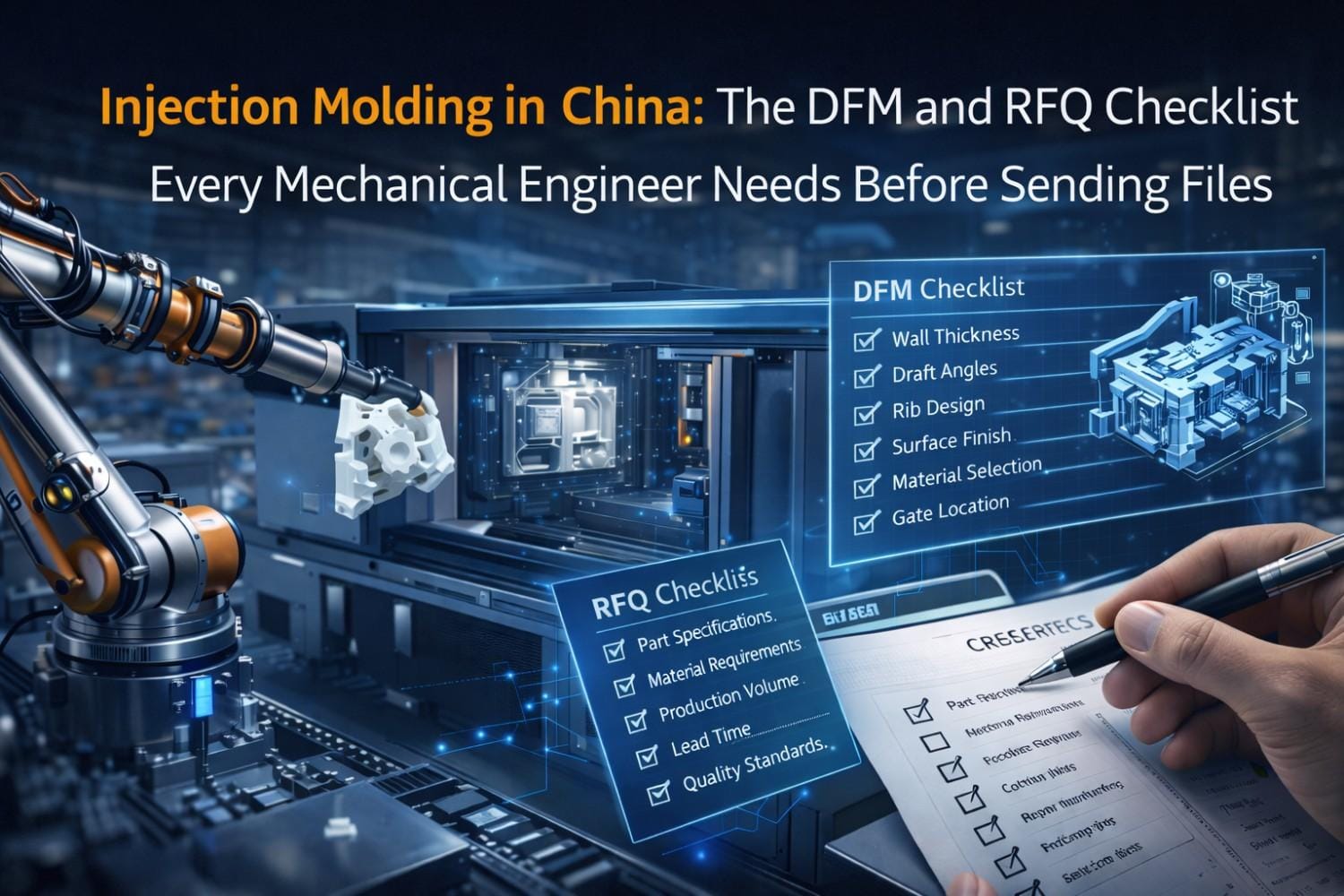
DFM checklist for injection molding:
| Rule | Recommended Value | Consequence of Ignoring |
| Wall thickness | 1.5–4.5mm, uniform | Sink marks, warping, short shots |
| Draft angle | Min 1°–2° per side | Part sticks in mould, tool damage |
| Rib thickness | 50–60% of adjacent wall | Sink marks on opposite face |
| Corner radii | Min 0.5mm internal | Stress concentration, cracking |
| Gate location | Away from visible/functional surfaces | Flow lines, witness marks |
| Undercuts | Minimise or design side-actions | Added tooling cost, longer lead time |
Run the DFM check on your CAD model before uploading to any supplier or platform. Most professional injection molding operations — whether a single factory or a marketplace — will return a DFM report before quoting, but catching issues yourself first eliminates the back-and-forth delay.
What Must a Complete RFQ for Injection Molding in China Include?
An RFQ for injection molding in China is defined as a formal document communicating all technical and commercial requirements a buyer needs a factory to quote against. Incomplete RFQs are the leading cause of non-comparable quotes: when three factories each assume a different material grade, tool steel, and surface finish, the resulting prices cannot be meaningfully compared.
A complete injection molding RFQ must include:
- 3D CAD file in STEP or IGES format
- 2D drawing with all critical dimensions, tolerances, and GD&T callouts
- Material specification with grade — ABS GP22, PC/ABS Cycoloy C6600, PEEK 450G — not just the polymer family
- Colour and surface finish to a defined standard — SPI A2, VDI 3400 texture ref, or RAL code
- Annual volume and target unit price — helps factories recommend appropriate tool steel grade
- T1 sample approval requirement before mass production is confirmed
- Quality documentation required — FAI report, material certificate, AQL inspection level
The more complete the RFQ, the more comparable the quotes and the fewer surprises after tooling begins.
How Do You Choose Between Injection Molding Suppliers in China?
Choosing between injection molding suppliers in China is best done across five dimensions: machine park and cavity capability, material and colourant processing range, quality management certification, secondary operation availability, and IP protection protocol. Price is an output of these factors — not a reliable standalone selection criterion.
Supplier evaluation criteria:
| Criterion | What to check | Why it matters |
| Machine tonnage range | Does it cover your projected clamping force? | Undersized machines produce incomplete fills |
| Tool steel grade quoted | Aluminium vs P20 vs H13 | Determines tool life and cycle accuracy |
| ISO 9001 certification | Current and audited | Baseline quality management assurance |
| Secondary operations | Assembly, insert moulding, painting | Reduces coordination with additional suppliers |
| IP protection protocol | NNN agreement before file sharing | Non-negotiable for any China factory |
The two main sourcing routes for injection molding suppliers in China are direct factory engagement and manufacturing marketplaces. Direct sourcing gives more control over the factory relationship but requires independent vetting, NNN drafting, and individual communication management for each supplier. Platforms like Haizol return competing quotes from pre-vetted injection molding suppliers in China within 24 hours with NDA coverage built in, which suits engineers running multiple projects simultaneously.
For buyers who need instant automated quotes for simpler geometries without account management, platforms like Xometry or Protolabs operate on a different model — immediate pricing from their own facility networks rather than multi-factory competition.
How Do You Protect IP When Sharing Design Files with Chinese Injection Molding Factories?
IP protection in China injection molding is defined as the contractual and legal measures a buyer puts in place before sharing design files, tooling drawings, or assembly specifications with any Chinese factory. The most common mistake engineers make is using a Western NDA — these are not enforceable in Chinese courts and provide no practical protection for injection molding tooling or design files.
The correct IP protection approach:
- Use a Non-Disclosure, Non-Use, Non-Circumvention (NNN) Agreement governed by Chinese law and filed under Chinese jurisdiction — not your home country’s law
- Register design patents in China before sharing files, not after tooling has been cut
- Never share full assembly drawings or runner and gate data until a contract is signed and a tooling deposit received
- Working through a marketplace that includes NNN coverage as a standard step removes the legal drafting burden — but verify this is actually in place, not assumed
What Quality Controls Should Be Specified for Injection Molded Parts from China?
Quality control for injection molding in China is defined as the inspection and documentation requirements a buyer specifies to ensure parts meet dimensional and cosmetic standards before they leave the factory. Establishing these requirements in the RFQ — rather than requesting them after T1 — is the difference between having a paper trail and negotiating one after problems appear.
Minimum quality requirements for every injection molding order from China:
- First Article Inspection (FAI): Full dimensional report on T1 samples against 2D drawing — every critical dimension measured and documented
- Material certification: Raw material batch traceability and manufacturer datasheet
- Cosmetic inspection: AQL Level II sampling for flash, sink marks, colour variation, surface defects
- Functional test: Define pass/fail criteria for assembly fit, snap-fit deflection, or pressure integrity where applicable
- Pre-shipment inspection: Physical inspection of the production batch before sealing for export — third-party or marketplace-coordinated
Frequently Asked Questions:
Injection molding in China is defined as the manufacture of plastic parts by injecting molten polymer into precision-machined steel or aluminium moulds, carried out at Chinese factories. China is the world’s largest injection molding supplier base, producing components for buyers across automotive, electronics, medical, consumer, and industrial applications globally.
Injection molding in China becomes economically viable from approximately 1,000 units for most part complexities, as tooling costs of $1,500–$15,000+ must be amortised across the production run to reach competitive per-unit pricing.
Chinese injection molding suppliers routinely process ABS, PC, PP, PEEK, PA6, PA66, POM, PMMA, TPE, TPU, and reinforced engineering-grade blends with glass or carbon fibre fill.
An NDA (Non-Disclosure Agreement) prevents disclosure only. An NNN agreement adds Non-Use and Non-Circumvention clauses — preventing the factory from using your design for their own production or bypassing you to sell directly to your customers. NNN agreements governed by Chinese law are the correct instrument for sharing injection molding files with Chinese factories.
Compare quotes on the same basis: tooling cost, unit price at identical volume, T1 lead time, tool steel grade, surface finish capability, and quality documentation included. Platforms that return multiple standardised quotes — such as Haizol’s injection molding service in China — make direct factory-to-factory comparison straightforward without requiring separate RFQ submissions to each supplier.
Direct factory sourcing makes sense when an engineer already has a trusted, verified Chinese injection molding relationship with a track record. Marketplaces add the most value for new sourcing relationships, complex part matching requirements, or projects where IP sensitivity makes independent factory vetting impractical.
Not necessarily. Engineers managing injection molding projects in China remotely use factory DFM reports, T1 dimensional documentation, and pre-shipment inspection reports as the audit trail. On-site visits add value for high-volume, high-complexity projects or when establishing a new long-term factory relationship.