
While modern car engines are a product of more than 100 years of engineering refinement, the basic mechanics remain surprisingly simple. Knowing how your engine works enables you to identify warning signs, speak intelligently with mechanics, and know what work needs to be done before a situation becomes critical.
Engines have become more complicated, with computers and emissions control systems, but the basic mechanical operations of an engine still follow predictable patterns.
The Four-stroke Cycle Explained
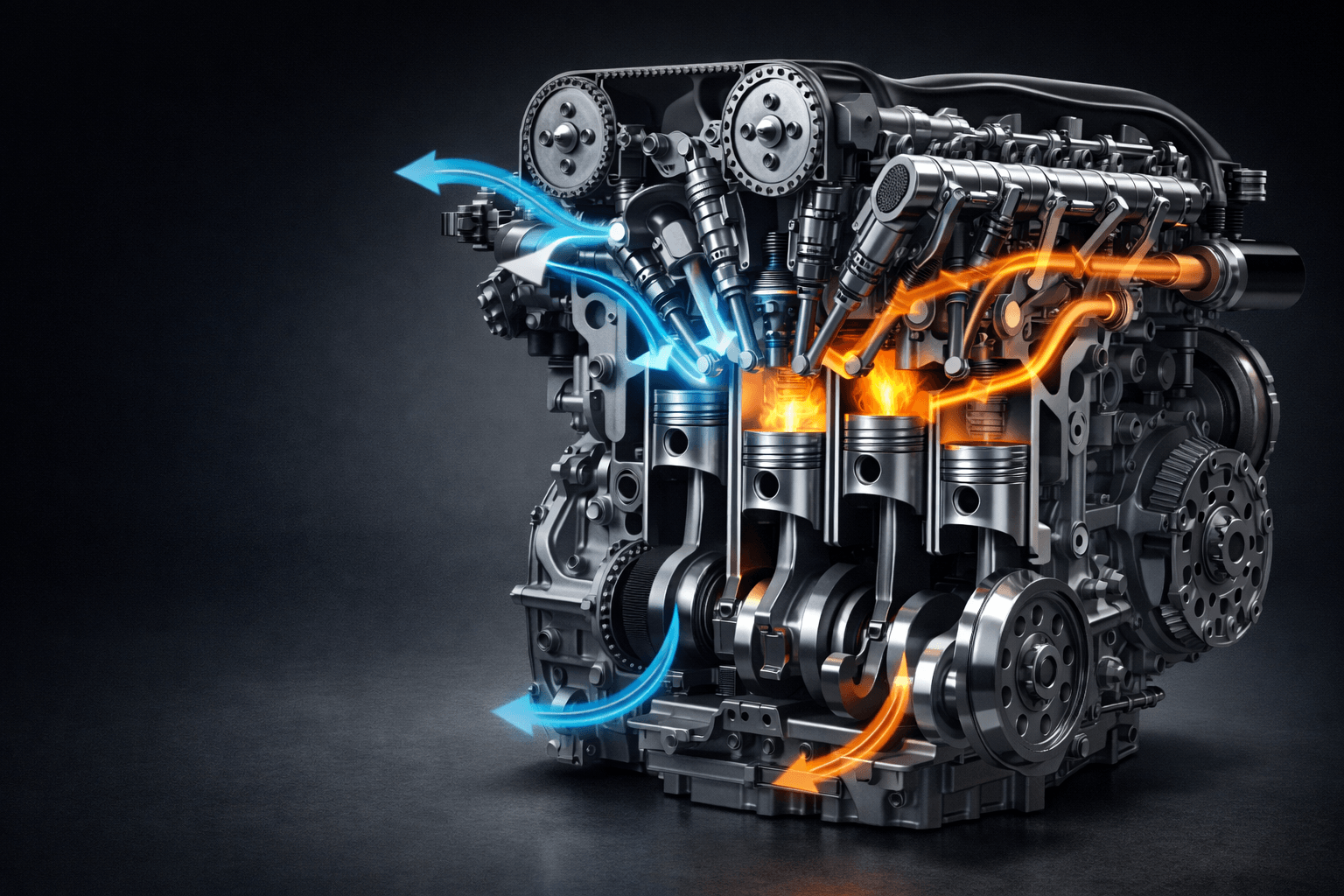
Most petrol engines work on a four-stroke cycle, and it happens faster than you’d ever notice. It starts when the piston drops and the intake valve opens, pulling in a rush of air that mixes with the fuel. Soon after this, it closes, and the piston heads back up for squeezing the fuel into a much tighter space until it’s ready to ignite.
At that point, the spark plug ignites the fuel, and the piston is driven downward hard to generate the power that actually moves the car. Once that energy is spent, the exhaust valve opens, and the burnt gases are removed to make room for it to start again.
The engines available today usually only have around 30 to 35% thermal efficiency. So, only a third of the energy in your fuel tank is pushing the car, and the remaining is lost as heat. This is why cooling systems are so crucial in vehicles.
How Components Work Together
The crankshaft converts the pistons’ up-and-down motion into circular rotation, which in turn makes the wheels rotate. Each piston is linked to the crankshaft by a pin joint, and its motion causes the crankshaft to turn.
The valvetrain includes cams, valves, and timing components that regulate the air entering the combustion chamber and the exhaust gases emitted from each cylinder. Lubrication systems circulate oil through the engine, preventing various metal parts from grinding against each other and causing a failure.
The cooling system keeps the engine at operating temperature by circulating coolant, which absorbs heat and cools in the radiator. If the needle on the temperature gauge starts to turn red, it could mean the coolant is leaking, the thermostat is failing, or the radiator is obstructed.
Forced Induction and Performance
Turbos and superchargers ram more air into the cylinders, allowing them to burn more fuel and make more power. While turbochargers rely on exhaust gases to power a turbine that drives a compressor, superchargers are typically driven via a belt or gear system.
Both are ways to make more power without increasing engine size, which is why so many modern vehicles are powered by smaller turbocharged engines rather than big naturally aspirated ones.
Resources for Better Understanding
Repair manuals have information for understanding and fixing a vehicle. You can find your vehicle’s specifications and even how to fix different issues in the manual. Flowcharts, diagrams, and details of all components make repair manuals for vehicles more specific than owner’s manuals.
Knowing how your engine operates makes you more than just a car owner, but an actual driver who knows when something’s not working right so they can take care of it. However, today’s engines are computer-controlled marvels; anyone with a can-do attitude can learn how to understand and maintain them.