
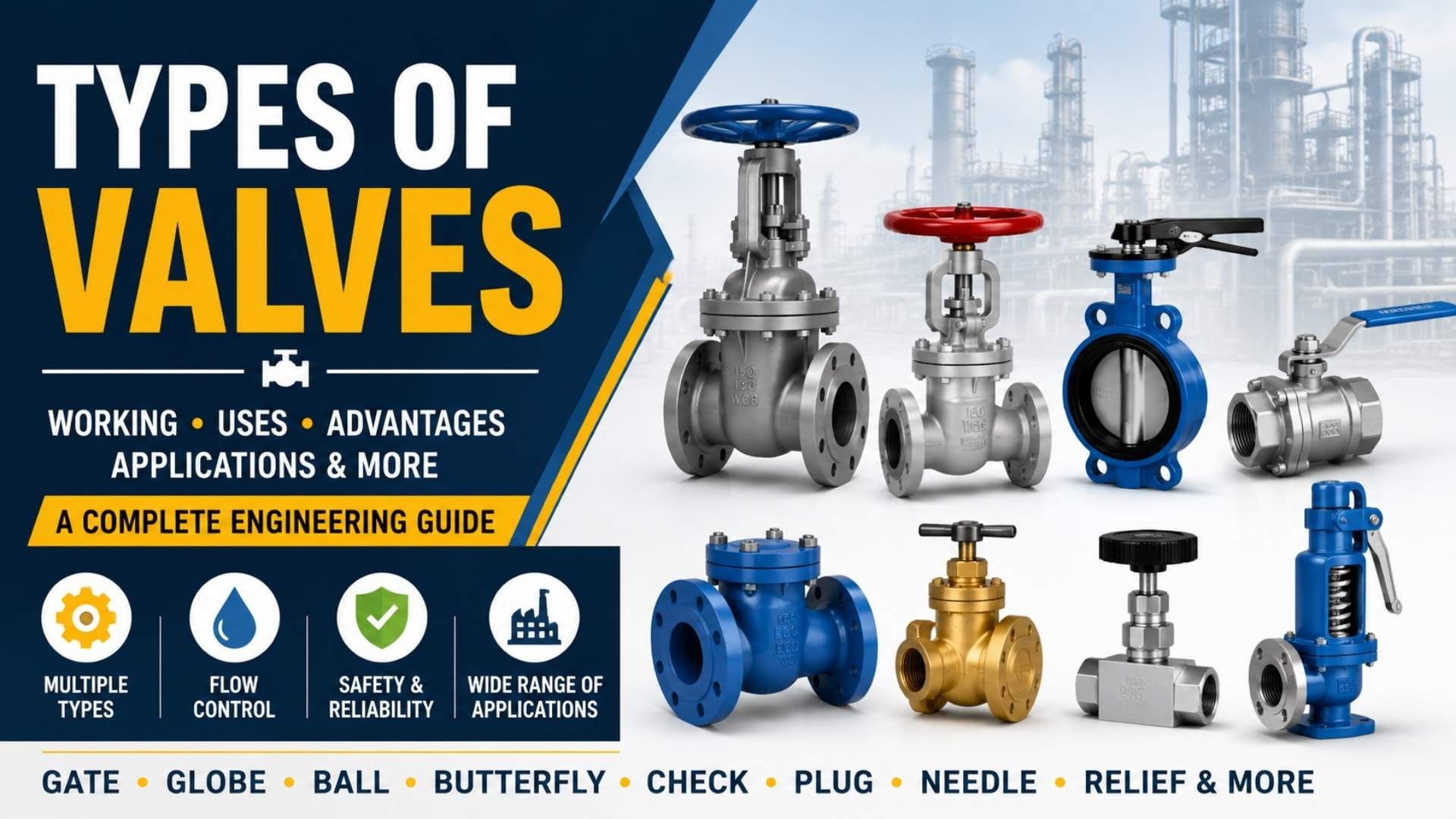
Valves are one of the most important mechanical components used in piping and fluid control systems. Whether it is a power plant, automobile engine, hydraulic machine, chemical factory, or even a home plumbing system, valves play a critical role in controlling the movement of liquids, gases, steam, and slurries. Simply put, a valve is a mechanical device used to regulate, start, stop, or direct fluid flow inside a system.
Without valves, industries would struggle to maintain pressure, regulate flow rates, or prevent backflow. From controlling steam in boilers to managing fuel supply in engines, valves help ensure efficiency, safety, and operational reliability. Different applications require different valve designs because no single valve can satisfy every operational need.
In this complete guide, we will discuss the different types of valves, their working principles, classifications, applications, advantages, disadvantages, and how to select the right valve for a system.
What is a Valve?

A valve is a mechanical device that controls the flow and pressure of fluids within a system or process. It works by opening, closing, or partially obstructing passages to regulate fluid movement.
Fluids controlled by valves include:
- Water
- Oil
- Steam
- Air
- Gas
- Chemicals
- Slurries
Valves are widely used in:
- Power plants
- Automobile industries
- Water treatment plants
- HVAC systems
- Oil and gas industries
- Chemical processing industries
- Hydraulic and pneumatic systems
Main Functions of a Valve
A valve performs several essential functions in industrial systems:
- Starting or Stopping Flow: Some valves completely stop or allow fluid movement.
- Flow Regulation: Valves can regulate fluid quantity depending on system requirements.
- Pressure Control: Special valves maintain or release pressure for safe operation.
- Direction Control: Certain valves direct fluid flow toward different pathways.
- Preventing Backflow: Non-return valves stop reverse flow and protect equipment.
Classification of Valves
Valves are classified in different ways based on operation, construction, movement, and application.
Major classifications include:
- Based on Function
- Based on Motion
- Based on Method of Operation
- Based on Design and Construction
Types of Valves Based on Design and Construction
1. Gate Valve
A gate valve is mainly used for fully opening or fully closing fluid flow. It is not suitable for throttling because partial opening can damage the valve.
Construction of Gate Valve
The main parts include:
- Valve body
- Gate (wedge-shaped disc)
- Stem
- Handwheel
- Seat
Working Principle
When the handwheel rotates, the gate moves upward or downward. Raising the gate allows fluid to flow, while lowering it blocks the passage completely.
Advantages of Gate Valve
- Low pressure drop
- Excellent sealing ability
- Suitable for high pressure systems
- Bidirectional flow capability
Disadvantages of Gate Valve
- Slow operation
- Not suitable for throttling
- Requires larger installation space
Applications
- Water supply systems
- Oil pipelines
- Steam systems
- Chemical industries
2. Globe Valve
A globe valve is mainly used for regulating or throttling fluid flow.
Construction
It contains:
- Movable disc
- Valve seat
- Stem
- Valve body
Working Principle
The disc moves vertically against the seat to control flow.
Advantages
- Excellent flow regulation
- Better shutoff performance
- Easy maintenance
Disadvantages
- High pressure drop
- Higher flow resistance
Applications
- Cooling systems
- Fuel oil systems
- Boiler feed systems
3. Ball Valve
A ball valve contains a rotating ball with a hole through its center.
Working Principle
When the hole aligns with the pipe, flow occurs. Rotating the ball 90° blocks the passage.
Types of Ball Valve
- Full Port Ball Valve: Provides unrestricted flow.
- Reduced Port Ball Valve: Has a smaller opening and slightly restricts flow.
- V-Port Ball Valve: Used for precise flow control.
Advantages
- Fast operation
- Leak-proof sealing
- Compact design
- Low maintenance
Disadvantages
- Poor throttling capability
- Seat wear at high temperatures
Applications
- Gas distribution
- Water systems
- Chemical industries
- Oil refineries
4. Butterfly Valve
A butterfly valve uses a rotating disc mounted on a shaft.
Working Principle
The disc rotates 90° to regulate or stop flow.
Advantages
- Lightweight
- Compact
- Quick operation
- Low installation cost
Disadvantages
- Moderate pressure handling
- Disc can obstruct flow
Applications
- Water treatment plants
- Fire protection systems
- HVAC systems
5. Plug Valve
A plug valve uses a cylindrical or tapered plug.
Working Principle
Rotating the plug aligns the opening with the pipe.
Advantages
- Quick operation
- Good shutoff ability
- Simple construction
Disadvantages
- High operating torque
- Wear issues
Applications
- Petroleum industries
- Chemical plants
6. Check Valve (Non-Return Valve)
A check valve permits flow in one direction only.
Working Principle
Fluid pressure opens the valve automatically. Reverse flow closes it.
Types of Check Valve
- Swing Check Valve: Uses a swinging disc.
- Lift Check Valve: Uses a lifting piston.
- Ball Check Valve: Uses a ball to stop reverse flow.
Advantages
- Prevents backflow
- Automatic operation
- Protects pumps
Disadvantages
- Water hammer problem
- Limited control
Applications
- Pumps
- Compressors
- Water pipelines
7. Needle Valve
A needle valve provides precise control of flow.
Working Principle
A needle-shaped plunger moves into a seat.
Advantages
- High precision
- Ideal for low flow rates
Disadvantages
- Slow operation
- Limited flow capacity
Applications
- Hydraulic systems
- Instrumentation systems
8. Diaphragm Valve
Uses a flexible diaphragm to control fluid.
Working Principle
The diaphragm presses against the seat to block flow.
Advantages
- Leak-free operation
- Corrosion resistance
Disadvantages
- Limited pressure range
Applications
- Food processing
- Pharmaceutical industries
9. Pressure Relief Valve
This valve protects systems from excessive pressure.
Working Principle
When pressure exceeds the set limit, the valve opens automatically.
Advantages
- Improves safety
- Prevents equipment damage
Applications
- Boilers
- Compressors
- Pressure vessels
10. Control Valve
Control valves automatically regulate pressure, temperature, and flow.
Working Principle
Actuators adjust the valve opening according to signals.
Types of Actuation
- Pneumatic
- Hydraulic
- Electric
Applications
- Automated industries
- Power plants
- Process industries
Types of Valves Based on Motion
Linear Motion Valves
These valves operate in a straight line.
Examples:
- Gate valve
- Globe valve
- Needle valve
- Diaphragm valve
Advantages
- Better sealing
- Suitable for precise control
Rotary Motion Valves
Operate using rotational movement.
Examples:
- Ball valve
- Butterfly valve
- Plug valve
Advantages
- Fast operation
- Compact size
Types of Valves Based on Operation Method
Manual Valves
Operated manually using:
- Lever
- Handwheel
- Gear
Automatic Valves
Operate automatically due to system pressure.
Example:
- Check valve
Actuated Valves
Operate through actuators.
Types:
- Electric valves
- Pneumatic valves
- Hydraulic valves
Valve Materials
Valve performance also depends on material selection.
- Cast Iron: Used for low-pressure applications.
- Stainless Steel: Corrosion-resistant and durable.
- Brass: Common in plumbing systems.
- Bronze: Good for marine applications.
- Plastic (PVC): Lightweight and corrosion resistant.
Difference Between Gate Valve and Globe Valve
| Feature | Gate Valve | Globe Valve |
| Purpose | ON/OFF | Flow regulation |
| Pressure Drop | Low | High |
| Speed | Slow | Moderate |
| Throttling | Not suitable | Suitable |
Difference Between Ball Valve and Butterfly Valve
| Feature | Ball Valve | Butterfly Valve |
| Cost | Higher | Lower |
| Space Requirement | More | Less |
| Shutoff | Excellent | Good |
| Pressure Handling | Better | Moderate |
How to Choose the Right Valve?
Selecting the right valve depends on several factors.
- Type of Fluid: Liquid, steam, gas, or chemicals.
- Pressure Requirement: Low, medium, or high pressure.
- Temperature: Some valves tolerate high temperatures better.
- Flow Requirement: Need for regulation or full flow.
- Maintenance Requirement: Ease of servicing matters.
- Cost: Budget limitations influence selection.
Common Valve Problems
- Leakage: Caused by damaged seats or seals.
- Corrosion: Occurs due to chemical reactions.
- Wear and Tear: Moving components wear over time.
- Sticking: Improper lubrication causes operation issues.
- Cavitation: Pressure drop creates vapor bubbles damaging surfaces.
Advantages of Valves
- Efficient flow control
- Improved system safety
- Better pressure management
- Prevents backflow
- Increases system efficiency
Disadvantages of Valves
- Maintenance required
- Pressure losses in some types
- Costly in large systems
Applications of Valves
Valves are used in many industries.
- Power Plants: Steam and water control.
- Automobile Industry: Fuel and exhaust control.
- Chemical Industry: Chemical flow regulation.
- Oil and Gas Industry: Pipeline control.
- Water Treatment Plants: Flow and pressure regulation.
- HVAC Systems: Air and cooling control.
Conclusion
Valves are essential components used to control, regulate, and direct fluid flow in almost every mechanical and industrial system. Different valve types are designed for different purposes, such as shutoff, throttling, pressure regulation, or preventing backflow. Understanding how each valve works helps engineers and technicians select the right option for safety, efficiency, and performance. Whether it is a gate valve for complete flow control, a globe valve for regulation, or a ball valve for quick operation, choosing the proper valve improves system reliability and reduces maintenance problems. To deepen your understanding, explore related topics like pumps, boilers, and piping systems.