
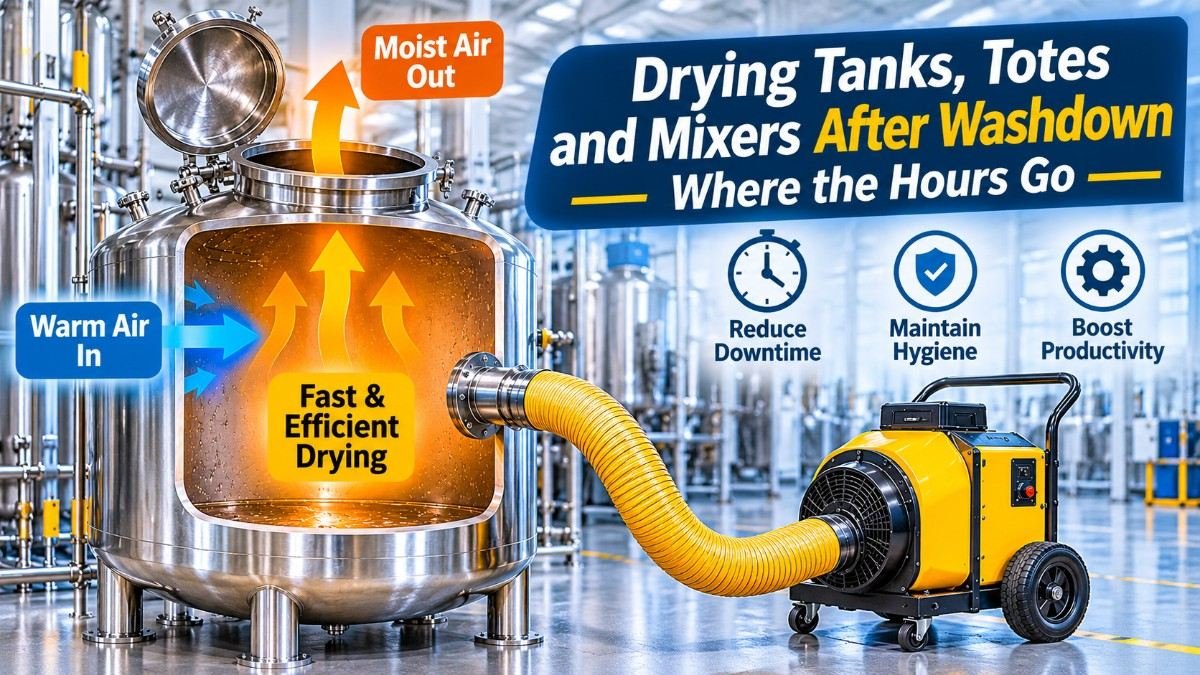
Cleaning a process vessel is usually well documented. Drying it often is not, even though the wait for a tank to dry can hold up production longer than the wash itself.
Why Water Lingers Inside a Vessel
A closed or partly closed vessel is a poor place for water to evaporate. Once the air inside is saturated, evaporation slows to almost nothing unless that humid air is replaced. Stainless steel walls cooled by the final rinse sit below room temperature, which slows drying further. Water also collects in the places that are hardest to reach: outlet valves, the corners of an IBC tote, the shaft seals of a mixer and the low points of connected piping.
Energy is part of the picture too. Evaporating a kilogram of water takes more than 2,200 kJ of heat (around 950 Btu per pound), so drying is ultimately a question of getting heat to the wet surface and carrying the moisture away.
The Common Methods and What They Cost
Leaving the lid open overnight is free, but it ties up the vessel for a shift or more, and in a humid plant it may never fully dry. Manual wiping is quick on an open tank. On anything an operator has to climb into, it becomes confined space work, which in the US falls under OSHA’s permit-required confined space rules (29 CFR 1910.146), with entry permits and an attendant posted outside.
Compressed air lances push water around more than they evaporate it, and compressed air is an expensive source for a job that needs volume more than pressure. Blowers fitted with electric heaters do work, but the heater adds kilowatts and a fire risk to the cart.
Volume, Heat And a Way Out
What actually dries a vessel quickly is a large volume of warm air going in and a clear path for the wet air coming out. Volume keeps replacing the saturated air near the walls, and warm air carries more moisture while it warms the steel. Both depend on the wet air having somewhere to go, so an open manway or outlet valve has to serve as the exhaust.
A blower can supply both the volume and the heat. Compressing air raises its temperature, and a blower selected for the job can deliver air hot enough to dry stainless steel without any heater element. Run through a hose into the vessel, an industrial tank dryer of this type can be wheeled on a cart from one tank or tote to the next, and the same unit can be pointed into connected piping.
Food, Pharma and Clean Air
In food and pharmaceutical plants, the drying air must not carry contamination into a vessel that has just been cleaned. A HEPA filter on the blower discharge deals with that, and it answers the auditor’s obvious question about where the drying air comes from. Post-CIP drying with filtered air fits within HACCP and GMP practice in a way that an open lid in a busy plant does not.
Measuring the Gain
The number to track is the time from end of rinse to vessel ready. Time it on a few typical cycles with the current method, including any wait for someone to come and wipe, then repeat with forced warm air. If drying was setting the pace of changeovers, the difference shows up directly in how many batches each vessel can handle in a week.