
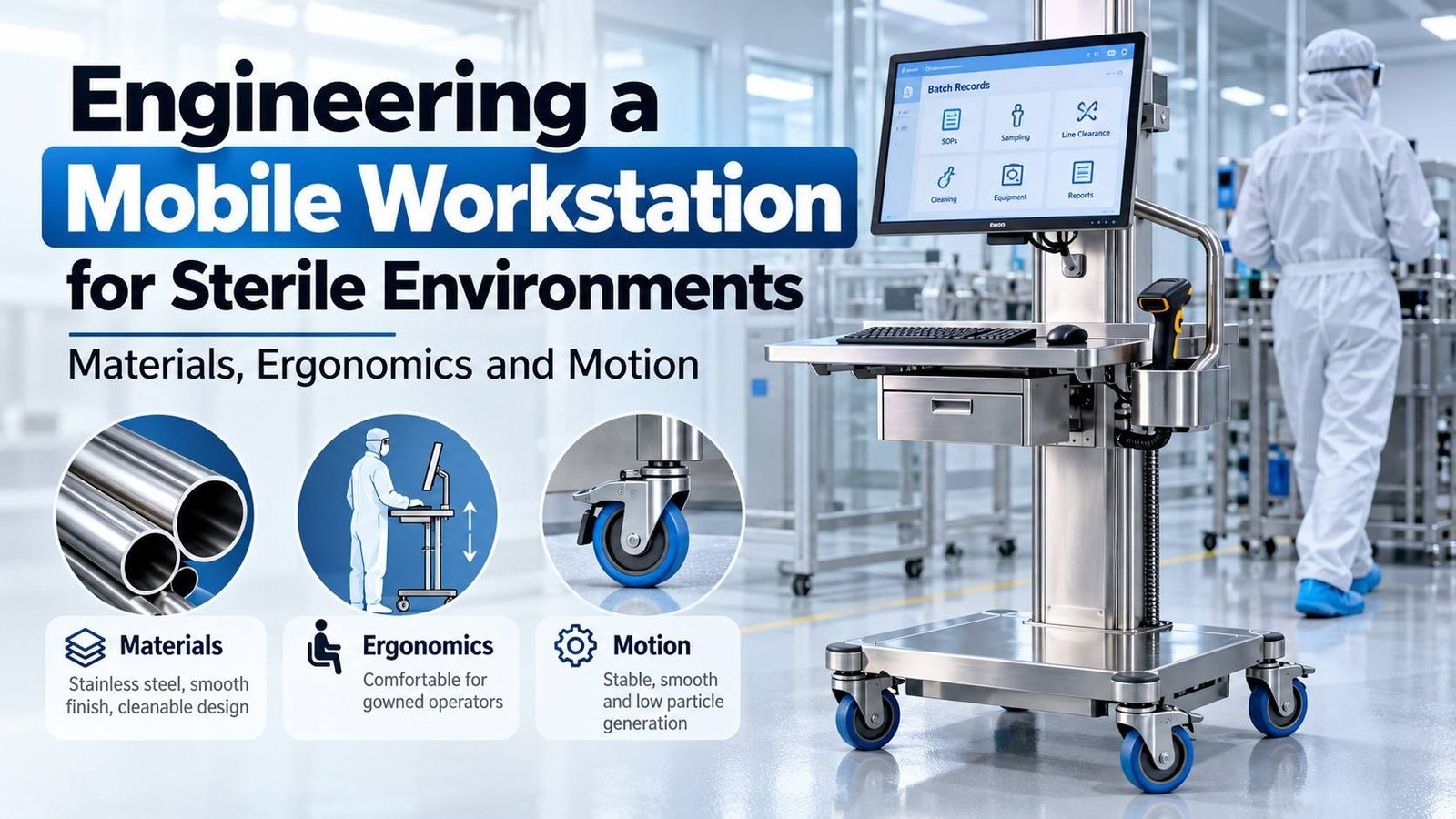
A wheeled workstation sounds like a simple product: a frame, a work surface, some casters and a screen. In a sterile pharmaceutical or biotech facility, it becomes a demanding piece of mechanical design. The station must be cleanable to the standards of a graded cleanroom, stable under load, comfortable for operators in full gowning, and able to roll between rooms and through airlocks thousands of times without shedding particles or loosening joints. Each of those requirements pulls the design in a slightly different direction.
Why Mobility Matters in Sterile Production
Fixed terminals are ideal where a task always happens in the same place. Many cleanroom activities are not like that. Line clearance, sampling, equipment setup, cleaning verification and material handling move around the room, and operators need access to electronic batch records and SOPs wherever they work. That is the use case for mobile operator stations for cleanrooms: carts that carry a computer, display, scanner and sometimes a printer to the point of use.
From a mechanical engineering point of view, the moving station introduces load cases that a wall-mounted panel never sees. It is pushed, pulled and occasionally bumped into door frames. It rolls over floor joints, threshold strips and airlock transitions. It is wiped from every angle, including the underside and the casters. And because it may be the only one of its kind in a suite, it has to be serviceable without being taken out of the classified area for long.
The design brief therefore combines contamination control, structural integrity and human factors. EU GMP Annex 1 expects equipment in cleanrooms to be designed for effective cleaning and to minimize particle generation. That expectation translates into very specific decisions about tube profiles, welds, fasteners and moving parts, and those decisions are far cheaper to make on the drawing board than after the first audit.
Materials and Surface Finish
Austenitic stainless steel is the default choice for cleanroom carts. AISI 304 is common in Grade C and D areas, while AISI 316L, with its molybdenum content and better resistance to chlorides and pitting, is often specified where aggressive disinfectants or sporicides are used. Surface roughness matters as much as alloy. A smooth finish, often specified by an Ra value of 0.8 micrometres or lower for product-contact equipment, reduces the area where residues and microorganisms can adhere. Workstations are not product-contact surfaces, but many manufacturers apply similar finishing standards because they make cleaning faster and more consistent.
Geometry follows the same logic. Round or oval tubing sheds liquid better than square sections with flat tops. Horizontal surfaces should be minimized or sloped. Welds should be continuous and ground smooth rather than stitched, since gaps between stitch welds are almost impossible to clean. Internal corners benefit from generous radii. Fasteners should be few, and where they are needed, dome nuts or concealed fixings avoid exposed threads.
Non-metallic parts need just as much scrutiny. Caster wheels, bumpers, handle grips and cable sleeves are typically polymer components, and they must tolerate repeated wiping with IPA and exposure to hydrogen peroxide, including VHP if the station stays in the room during decontamination. Polyurethane, certain grades of polyamide and silicone are common choices, but compatibility should always be verified against the actual disinfectants used on site rather than assumed from a generic chart.
Ergonomics for Gowned Operators
Operators in a cleanroom wear coveralls, hoods, masks, goggles and two layers of gloves. Their field of view is narrower, their dexterity lower and their tolerance for awkward postures shorter, because adjusting gowning is itself a contamination risk. A workstation that forces them to stoop or reach will be used badly or avoided.
Height adjustment is the most obvious ergonomic feature. A station used both standing and next to a bench should cover a range of heights for different users, and the adjustment mechanism itself should be cleanable. Gas springs and electric linear actuators inside sealed columns both work well, whereas exposed telescopic tubes with clamping levers create crevices and trap residues. Screen tilt is equally important, since overhead lighting in cleanrooms can produce glare on glass touchscreens, and an operator wearing goggles is already looking through two layers of glass.
Reach zones should be planned so that the keyboard or touchscreen, scanner and any label printer sit within comfortable reach without leaning across the cart. Handles should be positioned so that pushing force is applied close to the centre of mass, at a height suitable for most operators, and shaped to be gripped securely with gloved hands. Small details matter: a scanner holster that requires precise placement will be ignored, and the scanner will end up resting on a surface it was never meant to sit on.
Motion, Stability and the Casters
The casters are the most mechanically active component of a mobile station and frequently the most neglected. Cleanroom casters should have sealed bearings to avoid lubricant migration and particle release, wheels made from non-marking materials suited to epoxy or vinyl cleanroom floors, and housings made of stainless steel. Total lock brakes, which lock both wheel rotation and swivel, keep the station steady during use, which matters on touchscreens where any movement makes accurate input harder.
Stability calculations deserve real attention. A station carrying a display high on a column has an elevated centre of gravity, and the worst case is usually a lateral push at the top while one caster is crossing a threshold. A wider wheelbase, mass placed low in the chassis, often in the form of the battery pack, and careful positioning of the display arm all help keep the tipping margin comfortable. Push forces should be low enough for operators to move the station without strain, which favours larger wheel diameters, since these roll more easily over joints and transitions.
Finally, the station should be designed for its full life. Bearings wear, batteries age and wheels need replacement. Making these parts accessible with simple tools, and documenting maintenance in a way that fits the site’s GMP procedures, keeps the station in service and avoids improvised repairs that compromise cleanability. Good mechanical engineering here is invisible to the operator, which is exactly the point.