
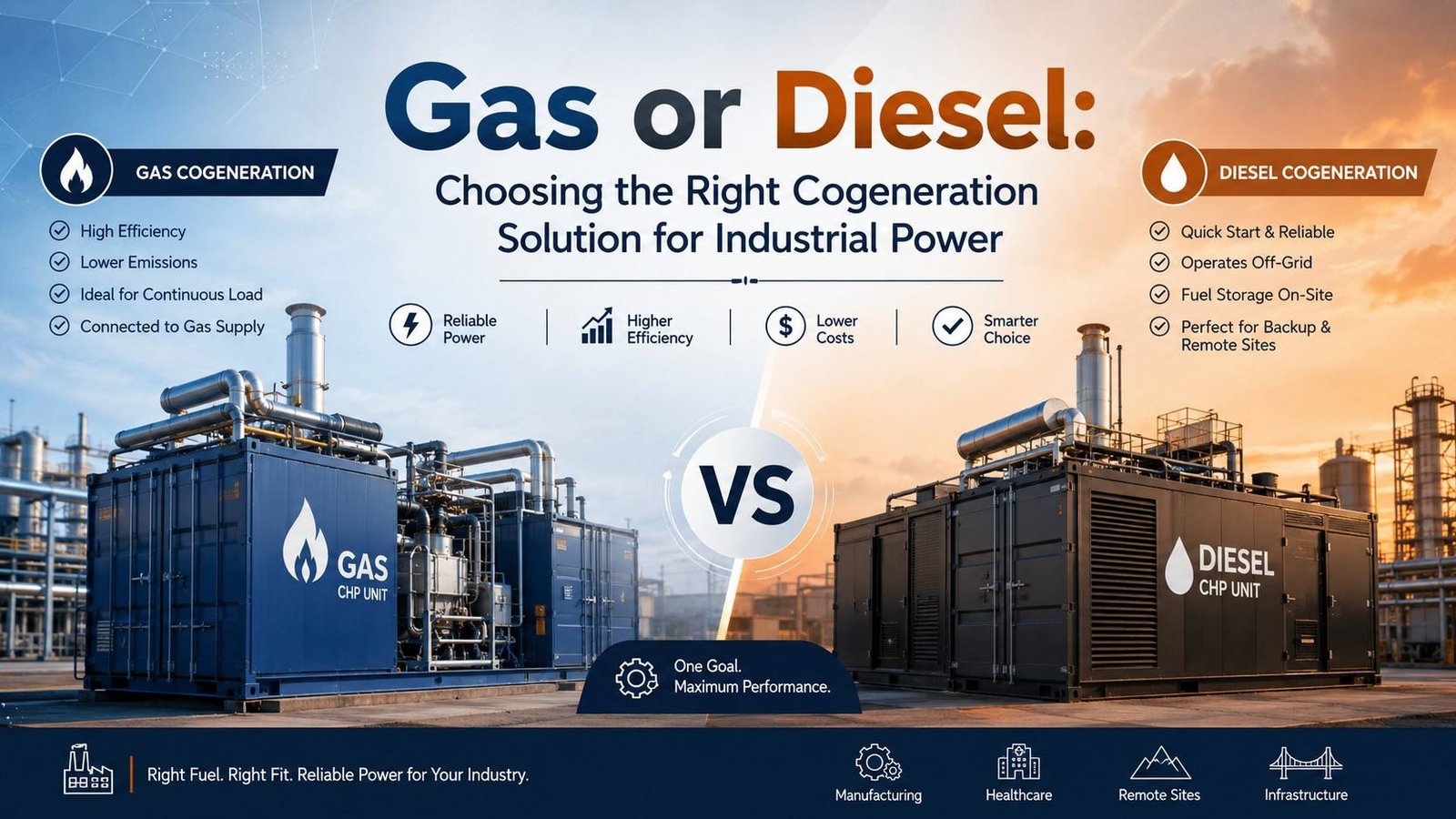
Energy costs and grid reliability have moved from background concerns to central topics. How do you keep power flowing without leaving continuity to chance? For many organisations, the answer increasingly lies in cogeneration.
Combined heat and power systems have been around for decades, but the choice of fuel behind them still shapes how well a system performs for a given site. Gas and diesel each bring their own distinct characteristics and understanding those differences is the first step to specifying a system that actually fits your operation rather than a generic one.
What Cogeneration Actually Does
Cogeneration, or CHP, generates electricity and captures the heat produced as a by-product for use elsewhere on site. Rather than losing that heat up a chimney, as a conventional power station would, a CHP unit puts it to work for space heating, hot water or industrial processes. The result is a system that gets far more useful output from the same unit of fuel than generating power and heat separately.
That’s how it works but the more interesting question for anyone specifying a system is which fuel source suits their site, and that’s where gas and diesel start to diverge.
Gas-based Cogeneration: Built for Continuous Load
Gas engines are the default choice where a site runs close to round the clock and heat demand is fairly predictable. Manufacturing plants or hospitals fall into this category, since they need a steady baseline of both power and heat rather than short bursts.
Gas CHP systems typically achieve strong overall efficiency because the engine can be tuned to run at a consistent load, which keeps both electrical output and heat recovery close to optimal. Emissions per unit of energy produced are also generally lower than diesel, which matters for organisations working towards carbon reduction targets or operating under tighter local air quality rules.
The trade-off is dependency on gas supply infrastructure. A site needs either a reliable mains gas connection or a stored supply of an alternative gas fuel such as LPG or biogas, which isn’t always practical in remote or temporary locations.
Diesel-based Solutions: Built for Speed and Certainty
Diesel takes a different role. Where gas suits predictable and continuous operation, diesel systems are chosen for their ability to start quickly, run reliably under variable load and operate without any dependency on a gas network at all.
This makes diesel the natural fit for backup power, temporary installations and sites operating off-grid or in locations where infrastructure is limited or unreliable. Construction sites, remote facilities and critical infrastructure that needs guaranteed standby capacity all lean towards diesel for exactly this reason. Fuel can be stored on site in large volumes, giving operators direct control over supply rather than relying on a connection they don’t manage themselves.
Diesel engines also tend to have a well understood maintenance profile, with parts and servicing widely available, which reduces the risk of extended downtime if something does go wrong.
Weighing Up the Decision
There’s no universal answer to gas versus diesel. The right choice depends on how a site actually operates.
Continuous, predictable demand with access to a gas supply generally favours a gas-based system, particularly where efficiency and emissions are priorities. Sites that need flexibility, rapid deployment or independence from grid and gas infrastructure tend to be better served by diesel.
Fuel choice in CHP remains a live issue nationally too. According to the UK government’s most recent Digest of UK Energy Statistics, gas continues to make up around two-thirds of the fuel used across the country’s CHP plants, underlining just how central it remains to the sector even as renewable fuel input slowly increases year on year. Diesel, meanwhile, holds its ground where continuity of supply matters more than fuel efficiency alone.
Site constraints matter just as much as fuel economics. Available space and planning restrictions as well as noise limits and time constraints can all tip the decision one way or the other.
Modular Systems are Changing the Calculation
One development worth factoring in is the shift towards modular, containerised CHP units. Rather than a bespoke build assembled entirely on site, these systems arrive largely pre-engineered, which cuts both installation time and the on-site risk that comes with traditional construction.
This matters for the gas-versus-diesel decision because it lowers the cost of getting it wrong. A modular unit can be commissioned faster, and in some cases reconfigured or scaled as a site’s needs change, which takes some of the pressure off getting every variable right from day one. For organisations weighing up modular cogeneration systems designed for rapid deployment, this kind of flexibility is often as important as the fuel choice itself.
Making the Right Call
Gas and diesel cogeneration each solve different problems well. Gas suits steady, continuous operation where efficiency and lower emissions carry weight. Diesel suits situations where speed, independence and guaranteed backup matter more than fuel economy.
For most organisations, the decision comes down to matching the technology to how the site genuinely runs, not to whichever option sounds more current. Getting that assessment right at the specification stage saves considerably more than it costs, both in performance over the system’s lifetime and in the disruption avoided if the wrong fit is chosen from the outset.
Explore More: