
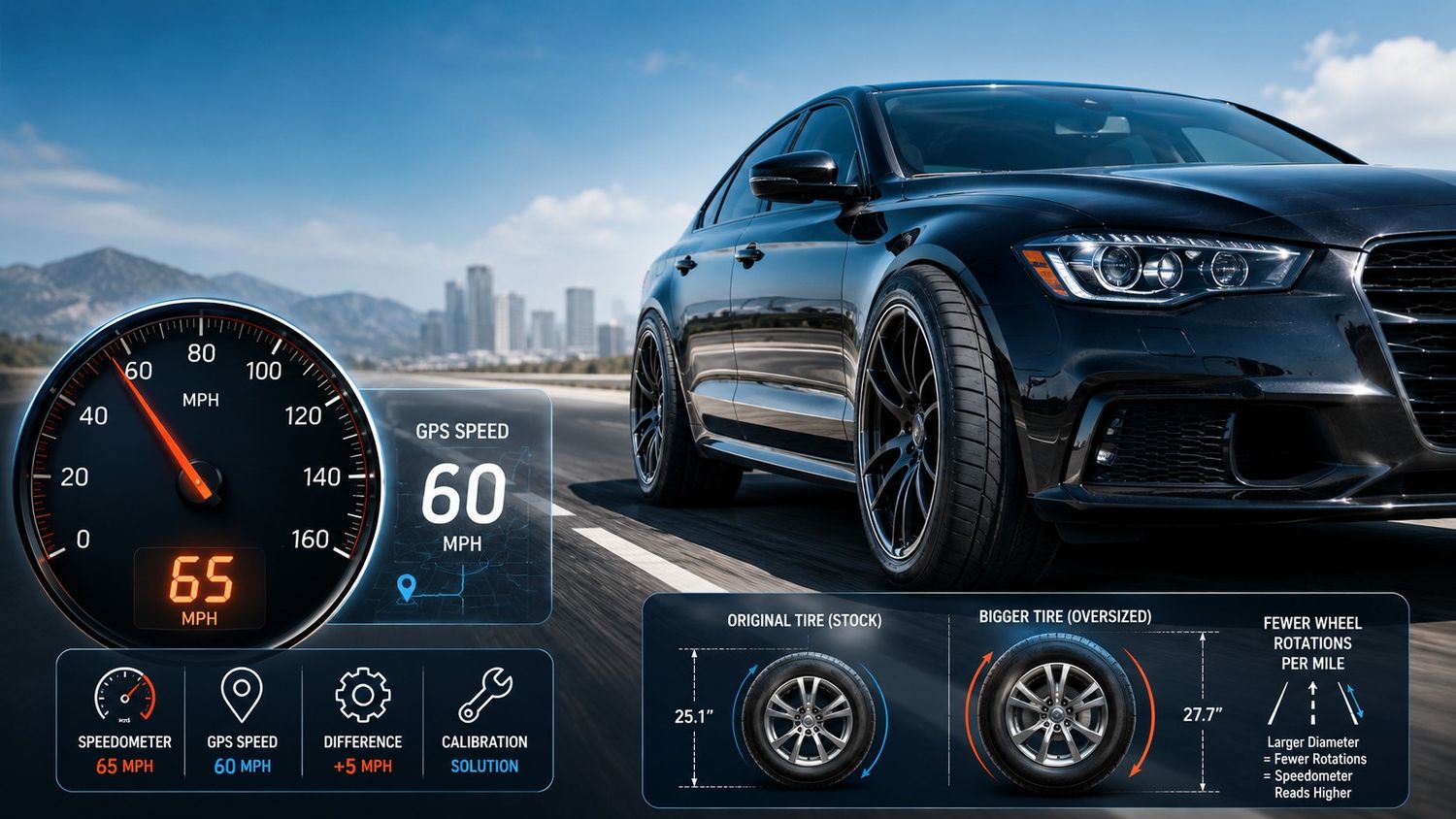
Swapping on a set of bigger tires can transform the look and capability of your vehicle, but it also quietly changes something you rely on every single drive: your speedometer. Before you lift your truck or upgrade to aggressive off-road rubber, it’s worth understanding exactly how tire size interacts with your speed and odometer readings, and what you can do about it.
Quick Answer
Yes, installing bigger tires affects your speedometer. Larger tires have a greater circumference, so they travel farther with each wheel rotation. As a result, your speedometer usually displays a lower speed than your vehicle’s actual speed. The larger the tire size increase, the greater the speedometer error.
Does a Bigger Tire Affect the Speedometer?
Yes. Any change in tire diameter changes the relationship between wheel rotation and actual road speed, which throws off your speedometer’s calculation.
Why does the error occur:
Your speedometer doesn’t measure speed directly. It counts how many times your wheels rotate and estimates speed based on the tire size the manufacturer programmed into the vehicle’s computer. When you install a taller tire, each rotation covers more ground than the factory tire did. The speedometer, still using the old math, thinks you’re going slower than you actually are.
One simple real-world example:
Imagine your factory tire is 27 inches in diameter, and you upgrade to a 30-inch tire. At a true speed of 65 mph, your speedometer might only show around 58-59 mph, because it’s still calculating based on the smaller factory tire’s revolutions per mile.
Why Does Tire Size Affect the Speedometer?
How a Speedometer Calculates Vehicle Speed
Modern speedometers don’t measure speed with a magic sensor pointed at the road. Instead, a sensor (usually on the transmission or wheel hub) counts wheel or driveshaft rotations. The vehicle’s computer then converts that rotation count into a speed reading using a pre-programmed tire circumference value, the one that matches your factory tire size.
Tire Circumference and Wheel Revolutions
Circumference determines how far a tire travels in one full rotation. A larger-diameter tire has a larger circumference, so it covers more distance per revolution. Fewer rotations are needed to cover the same distance compared to a smaller tire.
Why Larger Tires Cause Incorrect Readings
Since the onboard computer still assumes the original (smaller) circumference, it under-counts your actual distance traveled per rotation. This causes the speedometer, and odometer, to read lower than your true speed and distance.
How Much Does a Bigger Tire Affect the Speedometer?
The amount of error scales with how much larger the new tire is compared to the original. Below is a general reference chart showing approximate speedometer error at a true speed of 65 mph.
Speedometer Error Chart
| Original Tire | New Tire | Speedometer Shows | Actual Speed | Error |
| 27″ | 28″ | 65 mph | 67 mph | ~2 mph low |
| 27″ | 29″ | 65 mph | 70 mph | ~5 mph low |
| 27″ | 30″ | 65 mph | 72 mph | ~7 mph low |
| 27″ | 31″ | 65 mph | 75 mph | ~10 mph low |
| 27″ | 33″ | 65 mph | 79 mph | ~14 mph low |
| 27″ | 35″ | 65 mph | 84 mph | ~19 mph low |
Note: These values are approximate. Exact speedometer error depends on your specific original tire diameter, the new tire’s actual diameter, and your vehicle manufacturer’s speedometer calibration specifications. Always verify your own tire’s actual measured diameter rather than relying on sidewall markings alone.
Example Calculation
Speedometer error is straightforward to calculate once you know both tire diameters.
Formula:
Actual Speed = Indicated Speed × (New Tire Diameter ÷ Original Tire Diameter)
Complete example:
Let’s say your factory tire diameter is 28 inches, and you install a new tire with a 31-inch diameter. Your speedometer currently shows 60 mph.
Actual Speed = 60 × (31 ÷ 28)
Actual Speed = 60 × 1.107
Actual Speed ≈ 66.4 mph
So while your dashboard shows 60 mph, you’re actually traveling closer to 66 mph, over 6 mph faster than displayed. This gap grows larger the faster you drive, which is an important safety consideration in speed-limited zones or school zones.
What Else Changes When You Install Bigger Tires?
The speedometer isn’t the only system affected. Because so many vehicle functions rely on wheel-speed data, a tire size change can ripple through multiple systems.
Odometer Accuracy
Just like the speedometer, the odometer under-reports actual distance traveled. This can affect warranty mileage tracking, resale mileage disclosures, and maintenance interval scheduling.
Fuel Economy Calculation
Your dashboard’s MPG readout uses the same speed and distance data. With bigger tires, calculated fuel economy often appears worse than your car is actually achieving, since the computer thinks you’ve traveled less distance than you really have.
Automatic Transmission Shift Timing
Many automatic transmissions use road speed data to determine optimal shift points. Larger tires can cause shifts to happen later or at different RPMs than intended, potentially affecting performance and fuel efficiency.
ABS Performance
Anti-lock braking systems compare wheel speed sensor data across all four wheels to detect slipping. Significant tire size mismatches, especially side-to-side, can confuse the ABS module and trigger inconsistent braking behavior.
Traction Control
Traction control also relies on wheel speed comparisons to detect wheel slip. Inaccurate speed data from oversized tires can delay or misapply traction control intervention.
Stability Control
Electronic stability control uses wheel speed, steering angle, and yaw sensors together. Skewed wheel speed data from larger tires can reduce the system’s ability to accurately detect and correct a slide.
Cruise Control
Since cruise control maintains speed based on the same sensor data as your speedometer, your car may cruise at a different actual speed than what you set, often faster than intended with bigger tires.
Does a Smaller Tire Also Affect the Speedometer?
Yes, but in the opposite direction. A smaller tire has less circumference, so it completes more rotations per mile than the factory tire. This causes the speedometer to read higher than your actual speed, rather than lower.
Comparison Table
| Tire Change | Rotations per Mile | Speedometer Reading | Actual Speed |
| Bigger tire | Fewer rotations | Reads lower than actual | Faster than shown |
| Smaller tire | More rotations | Reads higher than actual | Slower than shown |
How to Correct the Speedometer After Installing Bigger Tires
Fortunately, speedometer error is fixable. Here are the most common correction methods, ranked roughly from most technical to simplest.
ECU Reprogramming
On many modern vehicles, the Engine Control Unit (ECU) can be reprogrammed with updated tire size data so the speedometer recalculates speed correctly. This typically requires specialized diagnostic software.
PCM Calibration
Similarly, the Powertrain Control Module (PCM) in some vehicles, especially trucks, stores tire size and axle ratio data used for speed calculations. Updating this calibration corrects both speedometer and shift timing issues.
Dealer Calibration
Dealerships often have access to manufacturer-specific calibration tools that can input your exact new tire size and recalibrate the speedometer to factory-level accuracy.
Aftermarket Calibration Tools
Handheld tuners and programmers designed for trucks and off-road vehicles let you manually input your new tire diameter, automatically correcting speedometer, odometer, and sometimes shift point data.
Smartphone GPS Verification
As a quick, no-cost sanity check, GPS-based speed apps can help you compare your indicated speed to your actual GPS speed. This won’t fix the error, but it helps you understand how far off your speedometer really is until you get it professionally corrected.
Pros and Cons of Installing Bigger Tires
| Pros | Cons |
| Improved ground clearance and off-road capability | Speedometer and odometer inaccuracy |
| More aggressive, upgraded appearance | Reduced fuel economy (real and displayed) |
| Better traction in certain terrain | Altered shift timing and drivetrain stress |
| Potential for wider tire contact patch | ABS, traction, and stability control errors |
| Can accommodate larger brake components | Possible speedometer-related driving violations |
| Additional cost for recalibration |
When Should You Recalibrate Your Speedometer?
Recalibration isn’t necessary for every tiny change, but you should strongly consider it in these situations:
- 1-inch increase or more in overall tire diameter
- After installing a lift kit, which often comes paired with larger tires
- When switching to larger off-road tires for trail or overlanding use
- After purchasing a new wheel and tire package with different specifications than stock
As a general rule, the bigger the diameter change, the more urgent recalibration becomes, both for accuracy and for legal compliance in speed-monitored areas.
Conclusion
Installing bigger tires almost always affects your speedometer, causing it to read lower than your actual speed because the larger tire’s circumference covers more ground per rotation than your vehicle’s computer expects. This same size change can also throw off your odometer, fuel economy readings, transmission shift timing, and safety systems like ABS, traction control, and stability control. If you’ve increased your tire diameter by an inch or more, especially after a lift kit or wheel/tire package upgrade, it’s worth recalibrating your speedometer through ECU reprogramming, PCM calibration, a dealer visit, or an aftermarket tuning tool. Taking this simple step keeps your speed readings accurate, your safety systems functioning properly, and your driving compliant with posted speed limits.
Frequently Asked Questions
Yes. Both the odometer reading and calculated fuel economy (MPG) are affected because they rely on the same rotation-based distance calculations as the speedometer.
Bigger tires alone typically won’t damage a transmission, but they do change effective gearing and shift timing, which can increase strain over time, especially with significantly larger, heavier tires.
GPS speed readings are generally very accurate and unaffected by tire size, making them a useful reference point for checking speedometer error, though satellite signal quality can occasionally cause minor fluctuations.
Laws vary by location, but driving with a speedometer that doesn’t reflect true speed can result in citations if you’re pulled over for speeding based on radar or lidar, even if your dashboard showed a legal speed.
Wheel diameter alone (the rim) doesn’t affect the speedometer. It’s the overall tire diameter (rim plus tire sidewall height) that matters, since that determines the tire’s total circumference.
On some vehicles, yes, using aftermarket programmers or OBD-II tools that allow manual tire size input; on others, professional calibration through a dealer or specialty shop is required.
Many drivers tolerate up to roughly a half-inch to one-inch diameter increase without major concern, but any noticeable size change benefits from recalibration for accuracy and safety.
Yes, to a smaller degree. Underinflated tires have a slightly smaller effective diameter, which can introduce minor speedometer error even without changing tire size.
Explore More