
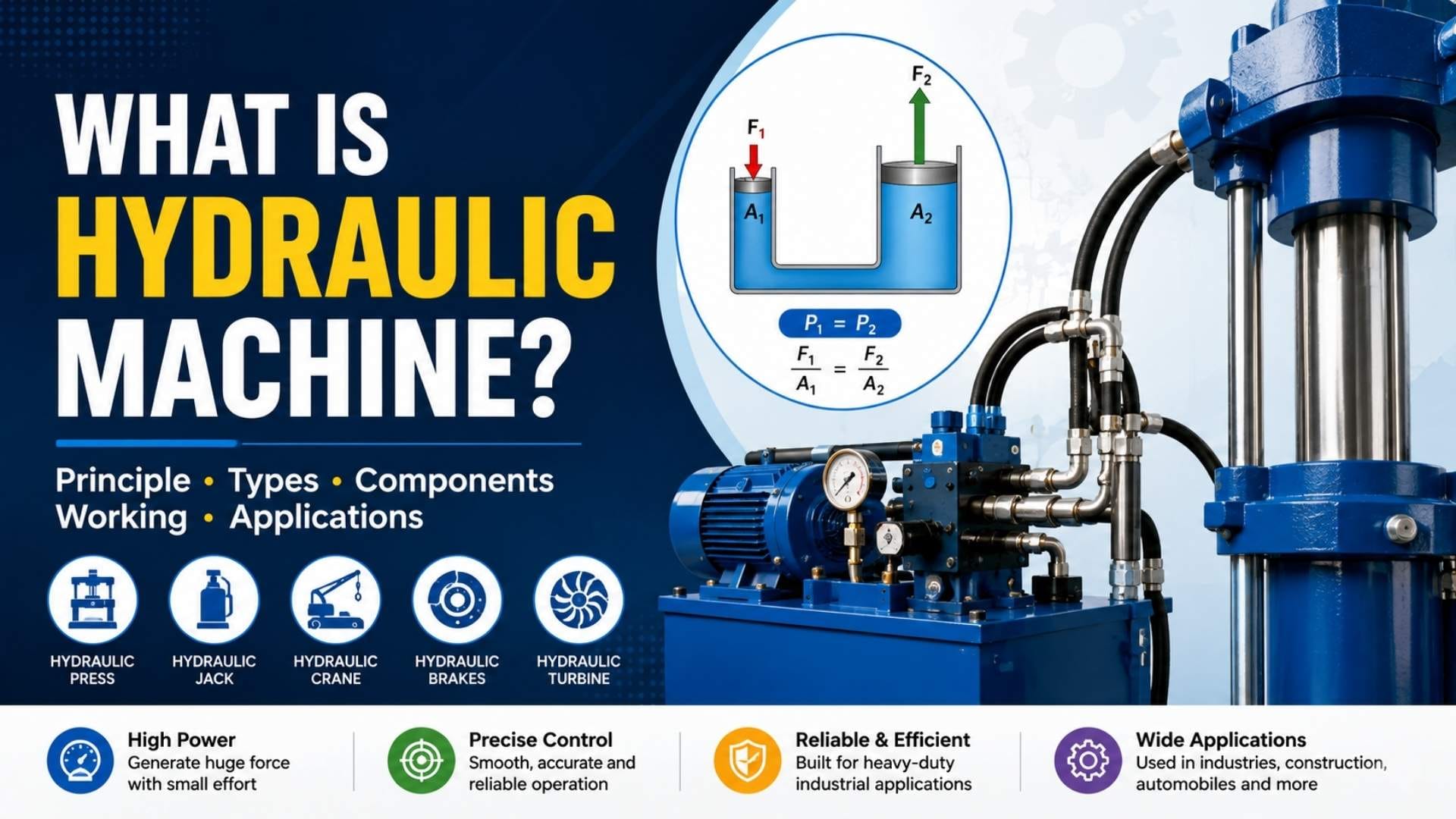
A hydraulic machine is a mechanical device that uses the power of liquids, mainly water or hydraulic oil, to transmit energy and perform useful work. These machines operate based on the principle that pressure applied to a confined fluid is transmitted equally in all directions, known as Pascal’s Law. Hydraulic machines are widely used in industries, construction equipment, automobiles, manufacturing systems, and power plants because they can generate very large forces with relatively small input effort.
From hydraulic presses and cranes to turbines and hydraulic brakes, these machines play a major role in modern engineering and industrial operations. Their ability to provide smooth, controlled, and efficient power transmission makes them essential in applications requiring heavy lifting, motion control, and energy conversion.
Principle of Hydraulic Machines
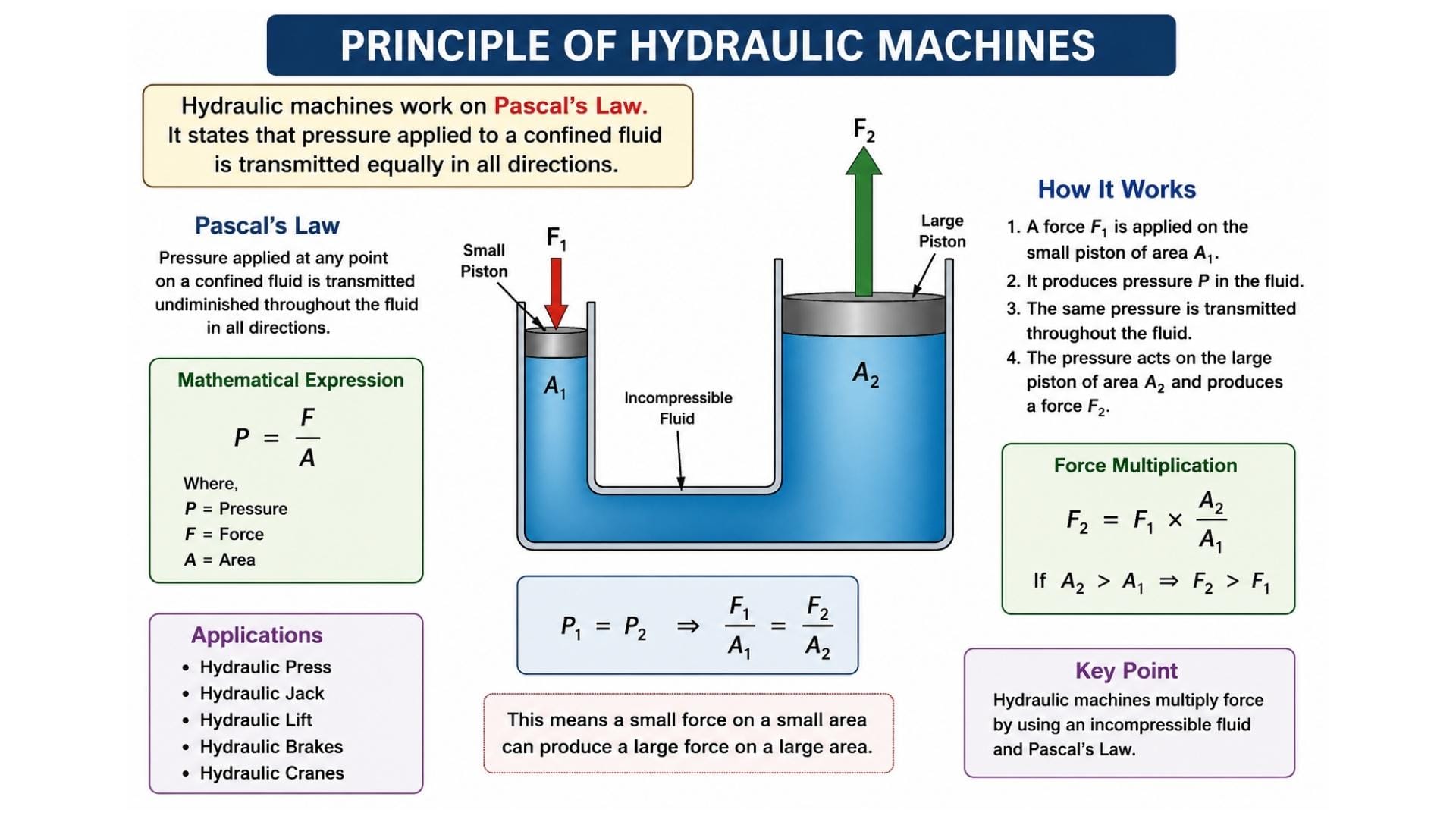
Hydraulic machines work on Pascal’s Law, which states that pressure applied to a confined fluid is transmitted equally throughout the fluid.
P=F/A
Where:
- P = Pressure
- F = Force
- A = Area
This principle allows a small force applied on a smaller piston to create a much larger force on a larger piston.
Types of Hydraulic Machines
Hydraulic machines are mainly classified into two categories:
1. Hydraulic Power Generating Machines
These machines convert hydraulic energy into mechanical energy.
Examples
- Hydraulic turbines
- Water wheels
Applications
- Hydroelectric power plants
- Renewable energy systems
2. Hydraulic Power Utilizing Machines
These machines use hydraulic energy to perform work.
Examples
- Hydraulic press
- Hydraulic jack
- Hydraulic crane
- Hydraulic lift
- Hydraulic brakes
Applications
- Automobile systems
- Construction machinery
- Industrial manufacturing
Main Components of Hydraulic Machines
Reservoir
Stores hydraulic fluid and helps in cooling and settling impurities.
Pump
Converts mechanical energy into hydraulic energy by moving the fluid.
Control Valves
Regulate pressure, direction, and flow rate of hydraulic fluid.
Actuator
Converts hydraulic energy into mechanical motion. It may be:
- Hydraulic cylinder (linear motion)
- Hydraulic motor (rotary motion)
Hydraulic Fluid
Acts as the medium for power transmission.
Working of Hydraulic Machines
The basic working process includes:
- Hydraulic fluid is stored in the reservoir.
- A pump forces the fluid into the hydraulic system.
- Pressure builds up inside the system.
- The pressurized fluid moves the actuator.
- Mechanical work is produced.
For example, in a hydraulic jack, a small force applied on the handle creates high pressure in the fluid, which lifts heavy loads using a larger piston.
Advantages of Hydraulic Machines
- High Force Generation: Can produce very large forces with small input effort.
- Smooth Operation: Provides controlled and vibration-free movement.
- Compact Design: Hydraulic systems can deliver high power in small sizes.
- Easy Control: Speed and direction can be controlled accurately.
- Overload Protection: Safety valves protect the system from excessive pressure.
Disadvantages of Hydraulic Machines
- Fluid Leakage: Leakage may reduce efficiency and create maintenance issues.
- High Maintenance: Requires regular inspection and fluid replacement.
- Heat Generation: Continuous operation can increase fluid temperature.
- Cost: Hydraulic components can be expensive.
Applications of Hydraulic Machines
Hydraulic machines are used in many engineering fields.
- Construction Industry: Excavators, Bulldozers, Hydraulic cranes
- Automobile Industry: Hydraulic brakes, Power steering systems, Car lifts
- Manufacturing Industry: Hydraulic presses, Injection molding machines
- Aerospace Industry: Aircraft landing gear systems, Flight control systems
- Power Generation: Hydraulic turbines in hydroelectric plants
Difference Between Hydraulic and Pneumatic Machines
| Feature | Hydraulic Machine | Pneumatic Machine |
| Working Fluid | Liquid | Air/Gas |
| Force Output | Very High | Moderate |
| Precision | High | Medium |
| Operating Pressure | High | Low |
| Applications | Heavy-duty systems | Light-duty automation |
Common Examples of Hydraulic Machines
- Hydraulic Press: Used for shaping, compressing, and forming materials.
- Hydraulic Jack: Used for lifting heavy vehicles and loads.
- Hydraulic Lift: Used in elevators and vehicle service stations.
- Hydraulic Brakes: Widely used in automobiles for efficient braking.
- Hydraulic Crane: Used for lifting and moving heavy materials.
Importance of Hydraulic Machines in Engineering
Hydraulic machines are essential because they:
- Improve efficiency in heavy operations
- Reduce human effort
- Enable precise motion control
- Increase industrial productivity
- Support large-scale power transmission systems
Their reliability and power capability make them one of the most important technologies in mechanical and industrial engineering.
Conclusion
Hydraulic machines are powerful systems that use liquid pressure to transmit energy and perform heavy mechanical work efficiently. From industrial presses and construction equipment to automobile braking systems and hydroelectric plants, their applications are found in almost every engineering sector. Their ability to generate high force, provide precise control, and ensure smooth operation makes them highly valuable in modern industries. Understanding the working principle, components, types, and applications of hydraulic machines helps in building a strong foundation in mechanical and industrial engineering concepts. For deeper understanding, you can also explore related topics such as hydraulic turbines, hydraulic presses, and fluid power systems.
taken some good information…..